Wednesday, January 09, 2013
card back
This is the image I used for the backs of the cards in my self-designed deck of tarots.
It was not originally intended as part of a deck of cards, but was simply something I doodled on an idle summer's afternoon in San Francisco years ago.
I drew and colored it in 1968 using pencil, a double-zero Rapidograph borrowed from my artist girlfriend, and magic markers on paper. It's 5" x 7", so it fit perfectly for use with my original tarot images, which are also five by seven.
The fronts of the cards were done between 1997 and 2001.
Click on the image to get a larger view. Photo and drawing ©2001, 2012 by Dave B, a.k.a. catboxer.
Saturday, January 05, 2013
baffled
Right. Well I managed to get a better image of this read (see post immediately below), but as the image has gotten clearer the meaning has gotten cloudier. These cards must be someone else's.
The momentum of the spread is toward romantic love. I'm going to be 69 years old this year, so that makes no sense at all.
The second theme in this layout is learning and study, which fits better with the true state of affairs. There's also a subtext of fiscal prudence and financial stability. I guess it's pretty much in the ballpark except the hearts. Unless I'm misreading them.
But I don't think I am, and that looks like someone else's life. But whose?
Click on the picture for a bigger view. Photo and images on cards ©2012, 2001 by Dave B a.k.a. catboxer.
--30--
The second theme in this layout is learning and study, which fits better with the true state of affairs. There's also a subtext of fiscal prudence and financial stability. I guess it's pretty much in the ballpark except the hearts. Unless I'm misreading them.
But I don't think I am, and that looks like someone else's life. But whose?
Click on the picture for a bigger view. Photo and images on cards ©2012, 2001 by Dave B a.k.a. catboxer.
--30--
Tuesday, December 25, 2012
reading for the new year
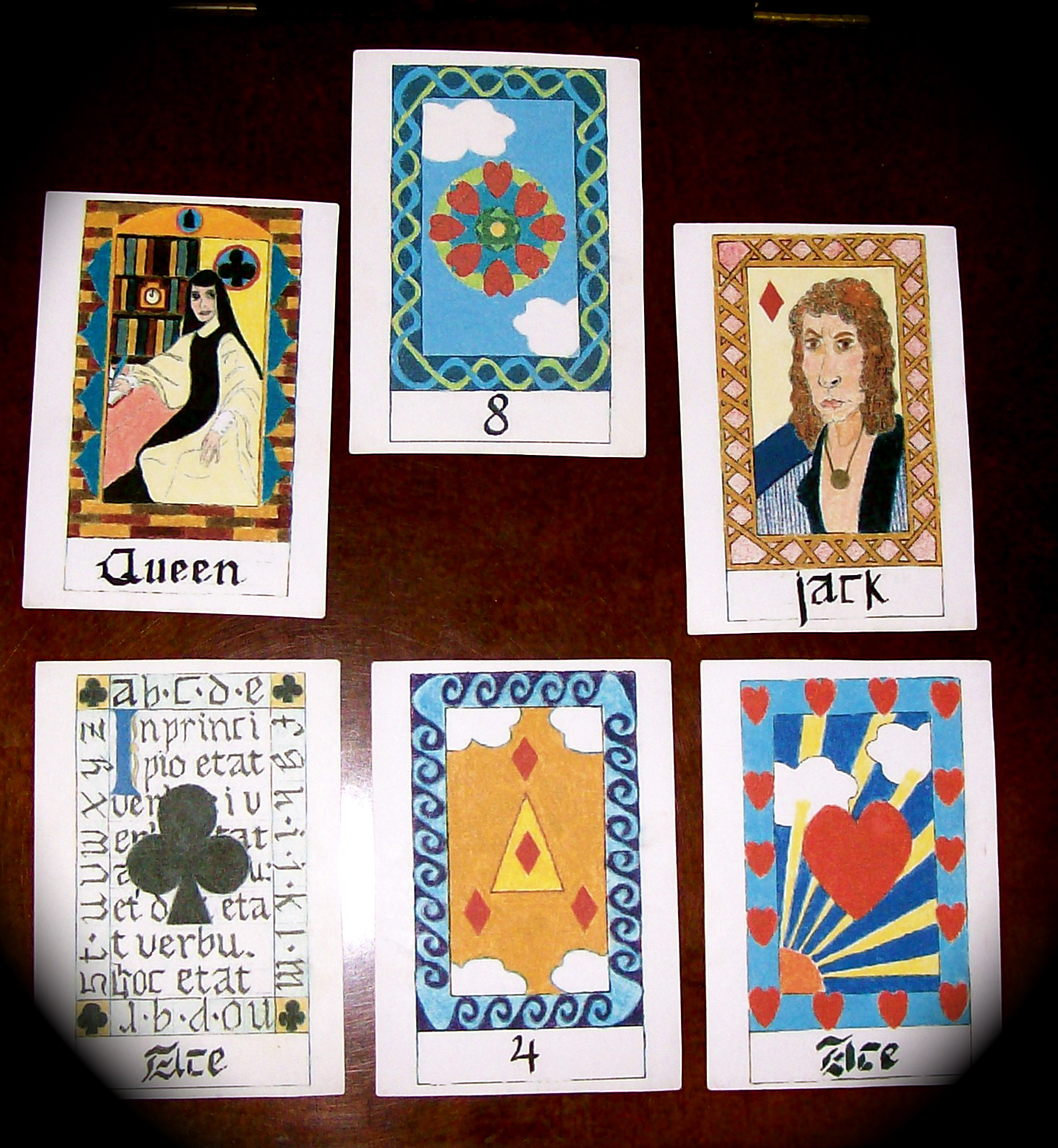
With the snow falling thick and fast on Christmas Day and beginning to accumulate, it's a good time to take a sounding on what's in store in the year ahead.
I used a new and, as far as I know, original layout this time, designating the bottom line of three cards as predicting developments in the gross or physical sphere of life, the pair just above forecasting the more abstracted, internal, and mental life, and the ultimate card at the top showing next year's focus of the spirit, geist, soul, or simply "the self."
The frequently symmetrical and seemingly patterned state of the cards I randomly draw (as in this case) looks deliberately arranged. At the bottom, a pair of aces bracket the four diamonds, and the center is a perfectly balanced pair of face cards.
The ace of clubs is all about new directions in reading, study, and learning. Hardly a month goes by that I don't draw a club card pointing to the importance in my life of this ongoing habit. Just as the ace of clubs means a desire for knowledge, or a new plan, scheme, or way of communicating, its partner, the ace of hearts, means a new love affair, or the desire for one, and the timing of this image is appropriate.
Between them is the four diamonds, representing financial stability and that most elusive of modern conditions, a balanced budget. That's a nice prospect, since it's one of my goals for next year.
Then comes the poetic, articulate, and knowledge-loving queen of clubs, consorting here with the materially-oriented, intelligent and calculating, and somewhat humorless money manager, the jack of diamonds -- a hard card to play I've heard.
At the top is love triumphant, and a romance brought to fruition, which at my age seems silly to contemplate, but who knows what might happen? Life is full of surprises.
So while I may be obsessed with studying art and art history next year, and will have my mind on my money and my money on my mind, this reading predicts that as always, love has dominion over all human affairs.
You can click on the picture for a bigger view, but it won't necessarily be a better one. My digital camera is misbehaving this morning as it oten does, so I used my cell phone to snap this one. If I get a better photo in the next couple of days, I'll replace this one.
Images on cards ©2001, 2012, by Dave B. a.k.a. catboxer.
Sunday, December 23, 2012
unlucky 13
So 2012 turns out not to have been the end of the world, but just another bad hair year.
Actually, it seems to me that the first 13 years of the new century have been more or less uniformly sucky.
I'm hoping that cycle, whatever it was, has run its course.
--30--
Actually, it seems to me that the first 13 years of the new century have been more or less uniformly sucky.
I'm hoping that cycle, whatever it was, has run its course.
--30--
Tuesday, December 18, 2012
Sunday, December 16, 2012
counter-images
I never read with reversed cards, because I've always felt like doing so would compromise clarity.
However, it occurs to me that many of these images have reverse or upside-down meanings, and that some of these are seen as commonplace images in popular culture. For example, here is the anti-queen of hearts, drawn towards the middle of the 19th century, by John Tenniel, to illustrate Lewis Carroll's "Alice's Adventures Underground."
And here is Carroll's less finished, and less comical, but decidedly scarier version of the same subject. It conveys the same nightmarish and at the same time slapstick impression as the rest of the book.
However, it occurs to me that many of these images have reverse or upside-down meanings, and that some of these are seen as commonplace images in popular culture. For example, here is the anti-queen of hearts, drawn towards the middle of the 19th century, by John Tenniel, to illustrate Lewis Carroll's "Alice's Adventures Underground."
And here is Carroll's less finished, and less comical, but decidedly scarier version of the same subject. It conveys the same nightmarish and at the same time slapstick impression as the rest of the book.
--30--
Friday, December 14, 2012
for a friend
I did this spread of three some time back, on the internet for a friend.
It's an unusual layout because two of the three cards are trumps. The likelihood of drawing two trumps to a three-card spread is about .088, that is, it will happen slightly fewer than nine times out of 100.
It's also an unusually auspicious consultation, anchored by the chariot trump, sometimes called "Victory."
Leading up to this period of triumph over enemies or circumstances is the creative and abundant empress trump.
Leading away from it is the security of financial stability, achieved with much difficult work which has yielded positive results.
Update: Look closely at the three cards, and you will spot two sevens, making this layout doubly auspicious.
The motto for this spread is "Ad astra, per asperam" (To the stars, with difficulty).
Click on the image for larger size and better clarity. Photo (2012) and images on cards ©2012, 2001, by Dave B, a.k.a. catboxer.
--30--
Tuesday, December 11, 2012
lone wolf reading
I'm used to seeing more cards than this, but now that I'm no longer half of a couple, I've reverted to the three-card monthly summary. The breakup has been gestating for a while, and was forecast in September.
No trumps here, but plenty of weight, starting with 10 pesos at left. This usually indicates that the subject of the reading, or "querent" as the person is sometimes styled, will do or has recently done (the latter in this case) a philanthropic act for a deserving person or people. It took me a while to figure out that in this case I'm the recipient of the gift, not the benefactor, since I recently moved back into the paid-for condominium my mother left to me and my sisters. Rents in Seattle have become very dear, and it's really nice to have a lovely and affordable place to keep the rain off.
The centerpiece, six spades, is the present moment, and the karmic result. Spades concern one's health and work, those closely interrelated facets of each of our lives. When this card shows up, it's telling us our habits and attitudes, good or bad, have determined the state of our health and work. For some reason this card often is feared, and so interpreted negatively. I had terrible health habits, and terrible health for many years, and pretty bad work habits as well, partly a result of poor health. The two chronic illnesses I have were one result. But for the last five years I've cultivated excellent health habits -- the usual lineup -- not smoking, close attention to diet, daily exercise -- and the results have been what my yoga grand-teacher Gary Kraftsow calls "optimal."
Also, I'm working. I'm a writer now. I don't get paid, but I write, take it seriously, and do it every day. And the only requirement for being a writer is to write.
Looking ahead, I see a lady. Another lady? Probably, and I don't think the Queen of hearts needs any interpreting. I've seen her before and not all that long ago, only she was behind me at the time rather than on the way ahead, which is also the only way we can go.
Mouse click on the image for a much larger and better view. Photo (2012) and tarot cards ©2001, 2012, by Dave B, a.k.a. catboxer.
--30--
No trumps here, but plenty of weight, starting with 10 pesos at left. This usually indicates that the subject of the reading, or "querent" as the person is sometimes styled, will do or has recently done (the latter in this case) a philanthropic act for a deserving person or people. It took me a while to figure out that in this case I'm the recipient of the gift, not the benefactor, since I recently moved back into the paid-for condominium my mother left to me and my sisters. Rents in Seattle have become very dear, and it's really nice to have a lovely and affordable place to keep the rain off.
The centerpiece, six spades, is the present moment, and the karmic result. Spades concern one's health and work, those closely interrelated facets of each of our lives. When this card shows up, it's telling us our habits and attitudes, good or bad, have determined the state of our health and work. For some reason this card often is feared, and so interpreted negatively. I had terrible health habits, and terrible health for many years, and pretty bad work habits as well, partly a result of poor health. The two chronic illnesses I have were one result. But for the last five years I've cultivated excellent health habits -- the usual lineup -- not smoking, close attention to diet, daily exercise -- and the results have been what my yoga grand-teacher Gary Kraftsow calls "optimal."
Also, I'm working. I'm a writer now. I don't get paid, but I write, take it seriously, and do it every day. And the only requirement for being a writer is to write.
Looking ahead, I see a lady. Another lady? Probably, and I don't think the Queen of hearts needs any interpreting. I've seen her before and not all that long ago, only she was behind me at the time rather than on the way ahead, which is also the only way we can go.
Mouse click on the image for a much larger and better view. Photo (2012) and tarot cards ©2001, 2012, by Dave B, a.k.a. catboxer.
--30--
Monday, December 10, 2012
Siggy
The picture was painted by Carl Jung as an illustration for his "illuminated manuscript," The Red Book, and shows Sigfried killing the dragon. Mouse click on the picture for a much larger and clearer view.
Sometimes I'll look at this and see myself fighting my diseases -- emphysema and Parkinson's -- and winning with the help of medication. If you're going to fight dragons, you can't be afraid.
-- That's "30" for now --
--Etaoin Shrdlu
Friday, November 30, 2012
why 74?
People sometimes ask me why my deck of tarot cards has 74 cards instead of the usual 78. I decided I wanted my work to have two definite characteristics, and achieving them involved some consideration.
First of all, I wanted my cards to have the look and characteristics of two distinct entities, thus 22 picture cards are grafted onto a modified 52-card playing card deck. This was the process by which tarot was originally created in Italy over 500 years ago, and if the usual suited tarot cards are different from the suited cards in my deck, they were, just the same, the playing card deck with which 15th-century Italians were familiar.
The originators of tarot added, besides the 22 picture cards (21 trumps + the fool) four cards to the suited portion of the pack (the queens), yielding four court cards in each suit, and 14-card suits. To our modern eyes, the tarot knight seems the interloper, but the Egyptian decks which were the forerunners and provided the template for European playing cards, were 52-card affairs with three courts in each suit -- the king and two male deputies.
The other characteristic I wanted in my tarot deck was to incorporate the playing-card pack the whole world uses today, the "international" deck with its 13-card suits. Its French-originated suit signs are really no different from the ones in a standard tarot deck, because hearts = cups, clubs = sticks, diamonds = coins, and spades = swords. And 13, a mysterious and prime number, works better than 14 for a suit of cards. There are four suits and four seasons, as well as four elements in the ancient concept of the physical universe. There are 13 weeks in a season and 52 weeks in a year. There's a certain mystical fascination with the number 13 in the lore of the early days of the US, and of course, the sinister association of the number with death, and its significance in the myth of the Last Supper.
There is a traditional line of thought that says the tarot deck was created out of whole cloth, as a seamless entity. This is easily disproved, since the importation of playing cards preceded the invention of the trumps, and the former, modified by the addition noted above, were clearly grafted onto the latter. A person could read with either part of the deck -- with the trumps alone or with the playing cards alone -- and in fact readers have employed both techniques at various times and places. Personally, I prefer the results of reading with the combined deck.
Photo and images on cards ©1968, 2001, 2012 by Catboxer a.k.a. Dave B.
--30--
First of all, I wanted my cards to have the look and characteristics of two distinct entities, thus 22 picture cards are grafted onto a modified 52-card playing card deck. This was the process by which tarot was originally created in Italy over 500 years ago, and if the usual suited tarot cards are different from the suited cards in my deck, they were, just the same, the playing card deck with which 15th-century Italians were familiar.
The originators of tarot added, besides the 22 picture cards (21 trumps + the fool) four cards to the suited portion of the pack (the queens), yielding four court cards in each suit, and 14-card suits. To our modern eyes, the tarot knight seems the interloper, but the Egyptian decks which were the forerunners and provided the template for European playing cards, were 52-card affairs with three courts in each suit -- the king and two male deputies.
The other characteristic I wanted in my tarot deck was to incorporate the playing-card pack the whole world uses today, the "international" deck with its 13-card suits. Its French-originated suit signs are really no different from the ones in a standard tarot deck, because hearts = cups, clubs = sticks, diamonds = coins, and spades = swords. And 13, a mysterious and prime number, works better than 14 for a suit of cards. There are four suits and four seasons, as well as four elements in the ancient concept of the physical universe. There are 13 weeks in a season and 52 weeks in a year. There's a certain mystical fascination with the number 13 in the lore of the early days of the US, and of course, the sinister association of the number with death, and its significance in the myth of the Last Supper.
There is a traditional line of thought that says the tarot deck was created out of whole cloth, as a seamless entity. This is easily disproved, since the importation of playing cards preceded the invention of the trumps, and the former, modified by the addition noted above, were clearly grafted onto the latter. A person could read with either part of the deck -- with the trumps alone or with the playing cards alone -- and in fact readers have employed both techniques at various times and places. Personally, I prefer the results of reading with the combined deck.
Photo and images on cards ©1968, 2001, 2012 by Catboxer a.k.a. Dave B.
--30--
Monday, November 26, 2012
the breakup card
The five hearts is the breakup card; that's for sure. At least I've never known it to be anything else.
When it showed in September I recalled the last time, in March of 2003, when it appeared in the same place -- top line, center of a nine-card "magic square," the sum of the future's spot -- as in the September recently passed.
In that earlier appearance, I wrote at the time that it looked like my wife and I would be breaking up at some point in the not-too-distant future, even though at that time the relationship appeared strong, almost bulletproof. But it wasn't, and dissolved over a period of months in 2006 and 2007.
Trying to figure out where I am right now with this manifestation of the old "cinco de corazones." Are we through with that thing and done with it, or is there more to come?
The thing about the suited cards, or Minor Arcana as some people like to call them, is their blunt and crystal-clear meanings, as opposed to the trumps, which are large and vague enough to lend themselves to endless re-interpretation.
I've considered attempting to read in the traditional Gypsy style, with a playing-card pack. That would produce an extremely blunt reading indeed.
When it showed in September I recalled the last time, in March of 2003, when it appeared in the same place -- top line, center of a nine-card "magic square," the sum of the future's spot -- as in the September recently passed.
In that earlier appearance, I wrote at the time that it looked like my wife and I would be breaking up at some point in the not-too-distant future, even though at that time the relationship appeared strong, almost bulletproof. But it wasn't, and dissolved over a period of months in 2006 and 2007.
Trying to figure out where I am right now with this manifestation of the old "cinco de corazones." Are we through with that thing and done with it, or is there more to come?
The thing about the suited cards, or Minor Arcana as some people like to call them, is their blunt and crystal-clear meanings, as opposed to the trumps, which are large and vague enough to lend themselves to endless re-interpretation.
I've considered attempting to read in the traditional Gypsy style, with a playing-card pack. That would produce an extremely blunt reading indeed.
Sunday, November 04, 2012
going into winter
There was no reading in October.
November's first interesting feature is that all three cards in the bottom row, indicating the recently unfolding past, were in September's spread.
The two trumps this month's fall in the upper left corner, as if the momentum of the reading is leaning toward the future and the feminine side.
Last month m'lady had eight hearts in the center (present) position in her (left-side) file; this month it's moved to the bottom, and its former spot is occupied by five clubs, signifying major changes in one's outlook, goals, and point-of-view.
The top of the file is the trump VIII - fortitude, usually called "strength" today. Its meaning is exactly what the name suggests.
The hub of this spread is three hearts: indecision and confusion in matters of love.
The right-side file, or male side of the reading, begins with the ace of spades, which was at the center of September's read. Four diamonds signifies stability in financial matters, but at a very modest level; restraint and discipline in money matters is necessary. At the top, six hearts is some karmic debt pertaining to love.
The center card at the top is the III trump, the empress, whose pregnancy promises a time of creativity in material pursuits.
Click on the photograph for a larger view.
See also, the September reading, posted immediately below.
Photograph and images on cards ©2001, 2012 by Dave B, a.k.a. catboxer.
November's first interesting feature is that all three cards in the bottom row, indicating the recently unfolding past, were in September's spread.
The two trumps this month's fall in the upper left corner, as if the momentum of the reading is leaning toward the future and the feminine side.
Last month m'lady had eight hearts in the center (present) position in her (left-side) file; this month it's moved to the bottom, and its former spot is occupied by five clubs, signifying major changes in one's outlook, goals, and point-of-view.
The top of the file is the trump VIII - fortitude, usually called "strength" today. Its meaning is exactly what the name suggests.
The hub of this spread is three hearts: indecision and confusion in matters of love.
The right-side file, or male side of the reading, begins with the ace of spades, which was at the center of September's read. Four diamonds signifies stability in financial matters, but at a very modest level; restraint and discipline in money matters is necessary. At the top, six hearts is some karmic debt pertaining to love.
The center card at the top is the III trump, the empress, whose pregnancy promises a time of creativity in material pursuits.
Click on the photograph for a larger view.
See also, the September reading, posted immediately below.
Photograph and images on cards ©2001, 2012 by Dave B, a.k.a. catboxer.
Wednesday, September 26, 2012
september song
The reading's only trump card, in the middle of the bottom row, reminds me of I Ching hexagram 51, whose judgment reads in part, "First laughing words -- ha ha; then shock comes -- ah ah!" So it was with us, beginning with laughter and infatuation, then quickly moving into a process dominated by fear and resentment.
It was the two queens, standing like protectresses on either side of the tower, who enabled us to get through that time. Hers, the pensive queen of spades, whose spiritual nature was formed out of pain and loss, and my queen of clubs. Even though she wears the habit and has taken the vow, she's more about knowledge and learning for its own sake than spiritual matters.
The lady's eight of hearts is indicative of "considerable emotional power, charm, and personal magnetism," according to Robert Camp*, and these qualities have enabled her to completely subdue the heart presently entwined with her own. The jack of clubs is the current unfolding of an ongoing theme, and the enthused young student is the most intense of all learners, cooking up spectacular results in his mind's oven when his subject is fresh, new, and exciting.
The ace of hearts usually means a new love relationship, or the desire for one. In this case it might mean an established relationship becoming new once more, like a flowering annual. The five of hearts next to it usually means a divorce, a breakup, or leaving one's family home. In this case, it more likely forecasts a significant change of residence which will occur November 1.
The nine of clubs tells us that whatever the jack is working so hard on will be completed in the near future. Robert Camp says of this card "it will signal a time when some ideas, ways of thinking or communicating, or some personal plans...are ready to end." This implies a new stage in one's thinking as well, possibly a synthesis of new material and old learning, with profitable results.
In the middle of it all, dominating the reading and drawing all the sequential lines of the spread's narratives into himself, sits the large, mute, and inscrutable ace of spades, the great keeper of secrets. He intervenes between the shock of recognition and the move across the water, pointing the way. He links the sadness of the mater dolorosa,, queen of spades, and the necessity of giving up familiar but obsolete ways of thinking. He also connects the queen of learning with the renewal of romantic love, and yokes the charisma of the center-left card with scholarly absorption on the right.
The ace of spades makes a cloudy lens, but it's through that we need to view these cards.
*All quotes from Robert Camp are from: Destiny Cards, (Sourcebooks, Inc., Naperville, IL), 1998.
Click on the image for a larger view. Photo and designs on cards ©2001, 2012 by Dave B, a.k.a. catboxer.
Tuesday, September 11, 2012
fancy and the ace of spades
Paul Christian was a 19th-century French journalist, historian, and occultist whose real name was Pitois. Cynthia Giles's "The Tarot: History, Mystery, and Lore," with its compact but comprehensive history section, includes a couple of pages on M. Christian and his work. Although Gile's discussion is intelligent and informed, she doesn't mention that it was this fellow Christian who originated the terms "major arcana" and "minor arcana."
Those names for the two divisions of the tarot deck, with their aura of mystery and mossy old age, go back to...1870? And they were just the point of departure for an elaborate, beautiful, over-the-top Oriental fantasy that culminated with initiation, underneath the pyramids, into an ancient Egyptian "mystery" religion, where neophytes were led into the circle composed of "78 gold leaves" which had once been housed in an extremely ancient temple in Memphis.
And so forth. "No factual basis was offered for the tale," Cynthia Giles notes, "but it swiftly became a part of the burgeoning background to the occult movment," along with the similar work of the American Ignatius Donnelly with his theory of the lost city of Atlantis. Even the golden plates found in a cave by another American, Joe Smith, who founded a new religion, were a similar sort of 19th-century fancy. Whether any of them actually believed what they wrote out of their exuberant imaginations is open to debate.
Christian was a scholar who got appointed to a position in the Ministry of Public Education at 28. His job was to sort through thousands of old books the revolutionary government had seized from monasteries in 1790, and a lot of them dealt with magic and alchemy. This was weird stuff for the modern age and, I imagine, pushed the young writer in occultic directions.
The thing about occultism is, it's the basis for an awful lot of contemporary approaches to tarot. If we don't have it, what have we got?
To start, we have a deck of cards, or rather two decks of cards, or to be very precise, a deck of 52 cards to which were added 4 court cards and 22 picture cards.
When I designed my own tarot, I decided to keep the 52-card deck and eliminate the 4th-ranked court card, and keep the queens and the usual 22 picture cards, making a deck of 74. Why there are usually four court cards in a tarot suit I don't know; it might have something to do with scoring the game, for the invention of the tarot pack as a gaming device which only later came to be used for divination, is beyond dispute.
There's a beauty and balance to the regular 52-card pack that I wanted to incorporate into my own. It mostly has to do with the 13-card suits, 13 being such a deliciously mysterious and immaculately prime number, compared to the clunky 14. Also, I grew up with the French suit signs, or the International deck as it's called nowadays, so adding the trumps to it seemed natural, just as adding them to a playing deck with suits of cups, sticks, coins, and swords would have seemed natural to a 15th-century Italian designer of games.
While they may seem plain as vanilla to aficionados of fanciful or occult tarots, some of the playing cards, even with their minimal imagery, resonate deeply in our culture: who doesn't understand the meaning of the queen of hearts, for example?
The Ace of spades is one of these. An ominous card, one of three associated with death (the others are the nine spades and, of course, trump XIII), the ace of spades conceals a secret. It was the center card in our reading this past weekend, and it sat there huge in the middle of the read, mute and secretive.
It was so big and so secretive I find it very disturbing.
Those names for the two divisions of the tarot deck, with their aura of mystery and mossy old age, go back to...1870? And they were just the point of departure for an elaborate, beautiful, over-the-top Oriental fantasy that culminated with initiation, underneath the pyramids, into an ancient Egyptian "mystery" religion, where neophytes were led into the circle composed of "78 gold leaves" which had once been housed in an extremely ancient temple in Memphis.
And so forth. "No factual basis was offered for the tale," Cynthia Giles notes, "but it swiftly became a part of the burgeoning background to the occult movment," along with the similar work of the American Ignatius Donnelly with his theory of the lost city of Atlantis. Even the golden plates found in a cave by another American, Joe Smith, who founded a new religion, were a similar sort of 19th-century fancy. Whether any of them actually believed what they wrote out of their exuberant imaginations is open to debate.
Christian was a scholar who got appointed to a position in the Ministry of Public Education at 28. His job was to sort through thousands of old books the revolutionary government had seized from monasteries in 1790, and a lot of them dealt with magic and alchemy. This was weird stuff for the modern age and, I imagine, pushed the young writer in occultic directions.
The thing about occultism is, it's the basis for an awful lot of contemporary approaches to tarot. If we don't have it, what have we got?
To start, we have a deck of cards, or rather two decks of cards, or to be very precise, a deck of 52 cards to which were added 4 court cards and 22 picture cards.
When I designed my own tarot, I decided to keep the 52-card deck and eliminate the 4th-ranked court card, and keep the queens and the usual 22 picture cards, making a deck of 74. Why there are usually four court cards in a tarot suit I don't know; it might have something to do with scoring the game, for the invention of the tarot pack as a gaming device which only later came to be used for divination, is beyond dispute.
There's a beauty and balance to the regular 52-card pack that I wanted to incorporate into my own. It mostly has to do with the 13-card suits, 13 being such a deliciously mysterious and immaculately prime number, compared to the clunky 14. Also, I grew up with the French suit signs, or the International deck as it's called nowadays, so adding the trumps to it seemed natural, just as adding them to a playing deck with suits of cups, sticks, coins, and swords would have seemed natural to a 15th-century Italian designer of games.
While they may seem plain as vanilla to aficionados of fanciful or occult tarots, some of the playing cards, even with their minimal imagery, resonate deeply in our culture: who doesn't understand the meaning of the queen of hearts, for example?
The Ace of spades is one of these. An ominous card, one of three associated with death (the others are the nine spades and, of course, trump XIII), the ace of spades conceals a secret. It was the center card in our reading this past weekend, and it sat there huge in the middle of the read, mute and secretive.
It was so big and so secretive I find it very disturbing.
Thursday, September 06, 2012
reaching the end
In the misty days of long ago, a group called Moody Blues had a song about "Knights in white satin, never reaching the end."
But that's ridiculous. We all reach the end sooner or later, and that's what this card is about. Today we call him the Hermit, and he carries a lantern which shines the light of knowledge which he has acquired in his solitude.
Originally, however, the lantern was an hourglass, and the various names the card was known by -- Time, the Old Man, and the Hunchback -- all point to the deterioration everybody who doesn't die young experiences. The age and condition of the figure on all versions of this card are reminiscent of the god Cronos (Saturn), from whom the symbolic content of the image derives.
The Old Man (Il Vecchio) is also the penultimate image of the first half of the trumps, which include the stations of rank and status in society (trumps I through V), then love and war (VI and VII), two eternal conditions young people everywhere and in all times deal with, and finally the Old Man/Hermit, a difficult situation that is, ironically, the best possible outcome.
The hourglass in the Visconti-Sforza version of Time, shown here, didn't last long, and by 1500, tarot's Old Man was carrying an object in his right hand which can't be identified, but which he holds up like a lantern. In my version, which is a portrait of the Swiss psychoanalyst C.G. Jung, from a photograph taken a few days before his death, I've retained the posture, but brought back the hourglass, nearly spent in this version, which is also a light source.
Click on images for a larger view; photo and tarot card "The Old Man" ©2001, 2012 by Dave B, a.k.a. catboxer.
--30--
But that's ridiculous. We all reach the end sooner or later, and that's what this card is about. Today we call him the Hermit, and he carries a lantern which shines the light of knowledge which he has acquired in his solitude.
Originally, however, the lantern was an hourglass, and the various names the card was known by -- Time, the Old Man, and the Hunchback -- all point to the deterioration everybody who doesn't die young experiences. The age and condition of the figure on all versions of this card are reminiscent of the god Cronos (Saturn), from whom the symbolic content of the image derives.
The Old Man (Il Vecchio) is also the penultimate image of the first half of the trumps, which include the stations of rank and status in society (trumps I through V), then love and war (VI and VII), two eternal conditions young people everywhere and in all times deal with, and finally the Old Man/Hermit, a difficult situation that is, ironically, the best possible outcome.
The hourglass in the Visconti-Sforza version of Time, shown here, didn't last long, and by 1500, tarot's Old Man was carrying an object in his right hand which can't be identified, but which he holds up like a lantern. In my version, which is a portrait of the Swiss psychoanalyst C.G. Jung, from a photograph taken a few days before his death, I've retained the posture, but brought back the hourglass, nearly spent in this version, which is also a light source.Click on images for a larger view; photo and tarot card "The Old Man" ©2001, 2012 by Dave B, a.k.a. catboxer.
--30--
Monday, September 03, 2012
the trump sequence
The main thing to keep in mind about the sequence of tarot trumps is that there really isn't one. This is not to say that there is no sequence that seems right to us (i.e., the one we're used to).
For most who are familiar with the cards, "the sequence" means the trump order of the Tarot de Marseilles. That was the sequence inherited by French occultists of the 19th century, and bequeathed by them to their English brethren of the early 20th, although Edward Waite tweaked the order slightly in his Rider-Waite-Smith pack, switching the places of VIII-Justice and XI-Strength. To this day, you can stumble into heated debates on tarot discussion boards in which participants either point with approval or view with alarm Edward Waite's determination of which card goes where.
It's actually a natural topic, since the Rider-Waite-Smith is easily the most popular deck in English-speaking countries, while the Tarot de Marseilles remains the favorite all over continental Europe. However, Waite's tinkering, and the strong objections of occultic "purists" to it, pales to insignificance when we consider that from the beginning there were regional variations in the trump sequence that render the notion of a "correct" order moot.
This is complicated by the fact that in the earliest tarot decks made for the nobility, the trumps weren't numbered; players at Tarocchi were expected to know how many points each trump was worth. Fortunately, there are still existing some tarot decks made for commoners, dating from roughly the same period as the luxurious, hand-painted items used by the crowned heads. These consist of several uncut sheets from two different crude and ugly woodcut decks. The trumps in both these decks are numbered, and the numbers show that they conformed to the trump sequence that prevailed in the tarot hotbed of Ferrarra in the early days.
The illustration shows 3-1/2 cards from one of these uncut sheets, this one housed at the Budapest Museum of Fine Arts. At left is a fragment of the Emperor card, identifiable only by the double-headed eagle on his shield, and his number (IIII) in the upper right corner of the card. Next to him is the Pope, identifiable from the crossed keys of St. Peter's and numeral V in the upper left corner. Next is the Empress, the upper part of whose image and number (II) are nearly eradicated, but who is identifiable by the double eagle on her shield. Lastly we have the Female Pope, wearing the papal tiara and holding the crozier, and sporting the number we moderns usually associate with the Empress (III), for to our eyes they have switched places.
That's not the only wrinkle in the Ferrarese order that "seems wrong" to modern tarot enthusiasts. There are numerous trumps which seem out of place, most notably Justice, which in this sequence is moved to the 20th spot. Maybe Waite was on to something, for I've found that in studying the various historical trump orders, there is more variety in the placement of the three virtues represented as females (Justice, Strength, and Temperance) than any of the other trumps.
Click on the image for a larger view.
--30--
For most who are familiar with the cards, "the sequence" means the trump order of the Tarot de Marseilles. That was the sequence inherited by French occultists of the 19th century, and bequeathed by them to their English brethren of the early 20th, although Edward Waite tweaked the order slightly in his Rider-Waite-Smith pack, switching the places of VIII-Justice and XI-Strength. To this day, you can stumble into heated debates on tarot discussion boards in which participants either point with approval or view with alarm Edward Waite's determination of which card goes where.
It's actually a natural topic, since the Rider-Waite-Smith is easily the most popular deck in English-speaking countries, while the Tarot de Marseilles remains the favorite all over continental Europe. However, Waite's tinkering, and the strong objections of occultic "purists" to it, pales to insignificance when we consider that from the beginning there were regional variations in the trump sequence that render the notion of a "correct" order moot.
This is complicated by the fact that in the earliest tarot decks made for the nobility, the trumps weren't numbered; players at Tarocchi were expected to know how many points each trump was worth. Fortunately, there are still existing some tarot decks made for commoners, dating from roughly the same period as the luxurious, hand-painted items used by the crowned heads. These consist of several uncut sheets from two different crude and ugly woodcut decks. The trumps in both these decks are numbered, and the numbers show that they conformed to the trump sequence that prevailed in the tarot hotbed of Ferrarra in the early days.
The illustration shows 3-1/2 cards from one of these uncut sheets, this one housed at the Budapest Museum of Fine Arts. At left is a fragment of the Emperor card, identifiable only by the double-headed eagle on his shield, and his number (IIII) in the upper right corner of the card. Next to him is the Pope, identifiable from the crossed keys of St. Peter's and numeral V in the upper left corner. Next is the Empress, the upper part of whose image and number (II) are nearly eradicated, but who is identifiable by the double eagle on her shield. Lastly we have the Female Pope, wearing the papal tiara and holding the crozier, and sporting the number we moderns usually associate with the Empress (III), for to our eyes they have switched places.
That's not the only wrinkle in the Ferrarese order that "seems wrong" to modern tarot enthusiasts. There are numerous trumps which seem out of place, most notably Justice, which in this sequence is moved to the 20th spot. Maybe Waite was on to something, for I've found that in studying the various historical trump orders, there is more variety in the placement of the three virtues represented as females (Justice, Strength, and Temperance) than any of the other trumps.
Click on the image for a larger view.
--30--
Wednesday, August 29, 2012
rota fortuna
How fitting that this common symbol of life's ups and downs, which was universally visible during Europe's middle ages, in manuscripts and carved into the stone walls of churches, should appear among the tarot trumps.
For many years I've conceptualized it as the circuit of an individual lifetime, as opposed to the other great wheel among the trumps, XXI-the World, which is the cycle of all lifetimes.
The wheel of fortune (today we call it "luck") has two components: karma, and the chance occurrence of random events.
Karma is sort of like destiny, but not exactly. For each of us, accumulated karmic results are effects -- the results of choices we've previously made. And of course, the very nature and the specific array of those earlier choices were themselves partly determined by karmic effects which accumulated in our lives up to that time. Thus the specific circumstances of our lives are at least in part an expression of who we are.
It's the meshing of karma with random and chance occurrences that produces the pattern familiar to everyone over the age of ten, and expressed in the old American hymn: Sometimes I'm up; sometimes I'm down.
The card in the lllustration, from the very early Visconti-Sforza deck (Milan, about 1460) conforms to the standard medieval presentation. The substitution of beasts for humans in the Tarot de Marseilles was an unfortunate variation, leading to the degenerated echo of of the original image visible in the confused occultism of most modern decks.
The medieval Wheel of Fortune portrays the karmic component of the cycle, but doesn't account for the undeniable and often crucial element of chance. My own card emphasizes chance, but at the expense of the karmic component. It would require a gifted artist-philosopher indeed to produce an image which comprehensively embraces the elements of this simultaneously simple and very complex concept.
Photo and design of X-Wheel of Fortune ©2012 by Dave B, a.k.a. catboxer. Click on images for a larger view.
For many years I've conceptualized it as the circuit of an individual lifetime, as opposed to the other great wheel among the trumps, XXI-the World, which is the cycle of all lifetimes.
The wheel of fortune (today we call it "luck") has two components: karma, and the chance occurrence of random events.
Karma is sort of like destiny, but not exactly. For each of us, accumulated karmic results are effects -- the results of choices we've previously made. And of course, the very nature and the specific array of those earlier choices were themselves partly determined by karmic effects which accumulated in our lives up to that time. Thus the specific circumstances of our lives are at least in part an expression of who we are.
It's the meshing of karma with random and chance occurrences that produces the pattern familiar to everyone over the age of ten, and expressed in the old American hymn: Sometimes I'm up; sometimes I'm down.
The card in the lllustration, from the very early Visconti-Sforza deck (Milan, about 1460) conforms to the standard medieval presentation. The substitution of beasts for humans in the Tarot de Marseilles was an unfortunate variation, leading to the degenerated echo of of the original image visible in the confused occultism of most modern decks.
The medieval Wheel of Fortune portrays the karmic component of the cycle, but doesn't account for the undeniable and often crucial element of chance. My own card emphasizes chance, but at the expense of the karmic component. It would require a gifted artist-philosopher indeed to produce an image which comprehensively embraces the elements of this simultaneously simple and very complex concept.
Photo and design of X-Wheel of Fortune ©2012 by Dave B, a.k.a. catboxer. Click on images for a larger view.
Tuesday, August 28, 2012
nine-card spread
The nine-card spread, which I have heard (but not confirmed) is known among the Rom as "the magic square," helps a reader achieve easy and logical interpretation.
It's like this: the bottom rank (horizontal line) is behind; the middle is happening now, the top lies ahead. The files (or vertical columns) are indicators of character: the left vertical is the moon, or the feminine, and the right column is the sun-masculine. The center represents the resulting combination of the two, in a whole human being, with built-in contradictions and conflicts.
This is an especially productive spread to use in a joint reading for a heterosexual couple, with each person represented by a vertical column, and the relationship between them developing through time, as revealed by the relationships in the horizontal ranks.
Studying relationships among the cards present in the two three-card diagonals can yield information as well.
Photo and images on cards ©2010, 2012 by Dave B, a.k.a. catboxer. Click on the photo for a larger view.
--30--
Thursday, August 23, 2012
guarlo and noquiklos, part 1
Not far from here there's a lake whose name has been lost in the slipping-away of time, but today is called Anderson Lake, and not so long ago a monster of the type we call a dragon lived on a rock in that lake. The people who fished and hunted and grew potatoes hereabouts called the solitary beast (for he had no mate) Noquiklos.
And even though, as I said, these things I'm going to tell you were not long ago, the world was much different then than the degraded and dissolute world we inhabit today. The surfaces of the streams were alive with salmon, who constantly dream of the open sea, and so unite the fresh waters with those of the great whulge.
The people hereabouts, being afraid of the beast, as is shown in the name they gave him, which means "demon," stayed far away, but even at a distance they could see the sunlight glinting off his golden scales as he sunned himself on his rock, which was called Tomanawos, and at night they could see the supernatural purple glow of his eyes shining through the forest darkness.
Then a young Chimakum warrior named Guarlo decided to put his fear aside and visit Noquiklos on his rock. He wanted to learn the secret of the animal's power, which had all humans living in fear of him.
Like all other Chimakum children, Guarlo's mother had warned him not to go near "the rock in the lake, or Noquiklos will eat you." But he wrapped his fear up in an otter skin, and stowed it in the rearmost nook of his canoe, and so paddled out to the rock Tomanawos. But the dragon was nowhere to be seen.
Guarlo beached his canoe in a perfect stillness; not even a breeze was stirring. He walked toward the stone cliff on the rock's landward side, and found a narrow cave opening about as tall as himself. Inside he saw the purple glow of the dragon's eye, and launched an arrow at it, but the beast easily dodged it, and a second shaft bounced harmlessly off the dragon's scales.
Guarlo realized his puny human-being weapons were useless against Noquiklos, and he gave up the fight. With resigned dignity, he backed away from the cave mouth, lay down on the flatness of the rock called Tomanawos, and composed himself to fearlessly meet his death.
--30--
And even though, as I said, these things I'm going to tell you were not long ago, the world was much different then than the degraded and dissolute world we inhabit today. The surfaces of the streams were alive with salmon, who constantly dream of the open sea, and so unite the fresh waters with those of the great whulge.
The people hereabouts, being afraid of the beast, as is shown in the name they gave him, which means "demon," stayed far away, but even at a distance they could see the sunlight glinting off his golden scales as he sunned himself on his rock, which was called Tomanawos, and at night they could see the supernatural purple glow of his eyes shining through the forest darkness.
Then a young Chimakum warrior named Guarlo decided to put his fear aside and visit Noquiklos on his rock. He wanted to learn the secret of the animal's power, which had all humans living in fear of him.
Like all other Chimakum children, Guarlo's mother had warned him not to go near "the rock in the lake, or Noquiklos will eat you." But he wrapped his fear up in an otter skin, and stowed it in the rearmost nook of his canoe, and so paddled out to the rock Tomanawos. But the dragon was nowhere to be seen.
Guarlo beached his canoe in a perfect stillness; not even a breeze was stirring. He walked toward the stone cliff on the rock's landward side, and found a narrow cave opening about as tall as himself. Inside he saw the purple glow of the dragon's eye, and launched an arrow at it, but the beast easily dodged it, and a second shaft bounced harmlessly off the dragon's scales.
Guarlo realized his puny human-being weapons were useless against Noquiklos, and he gave up the fight. With resigned dignity, he backed away from the cave mouth, lay down on the flatness of the rock called Tomanawos, and composed himself to fearlessly meet his death.
--30--
Tuesday, August 21, 2012
gujarati mama

Way up north, way up in Gujarat,
Where the nights are steamy and the days are hot,
And where the pretty women at,
I met a devotchka with a vonny plott.
But the only problem was she spoke only Gujarati,
And when your Gujarati's spotty makes it kind of hard to party
Yeah. The only problem was she spoke only Gujarati,
And if your Gujarati's missing you won't get any.
I was lying low for awhile in Ahmedabad
With a bum leg and a bad case of I-don't-cares.
Then she came and looked into my eyes,
Blew out all four tires and both spares.
But the only problem was she spoke only Gujarati...
--30--
Subscribe to:
Posts (Atom)