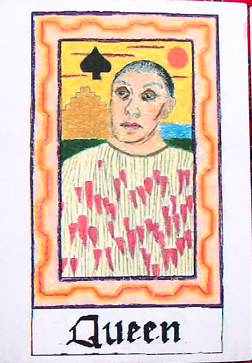
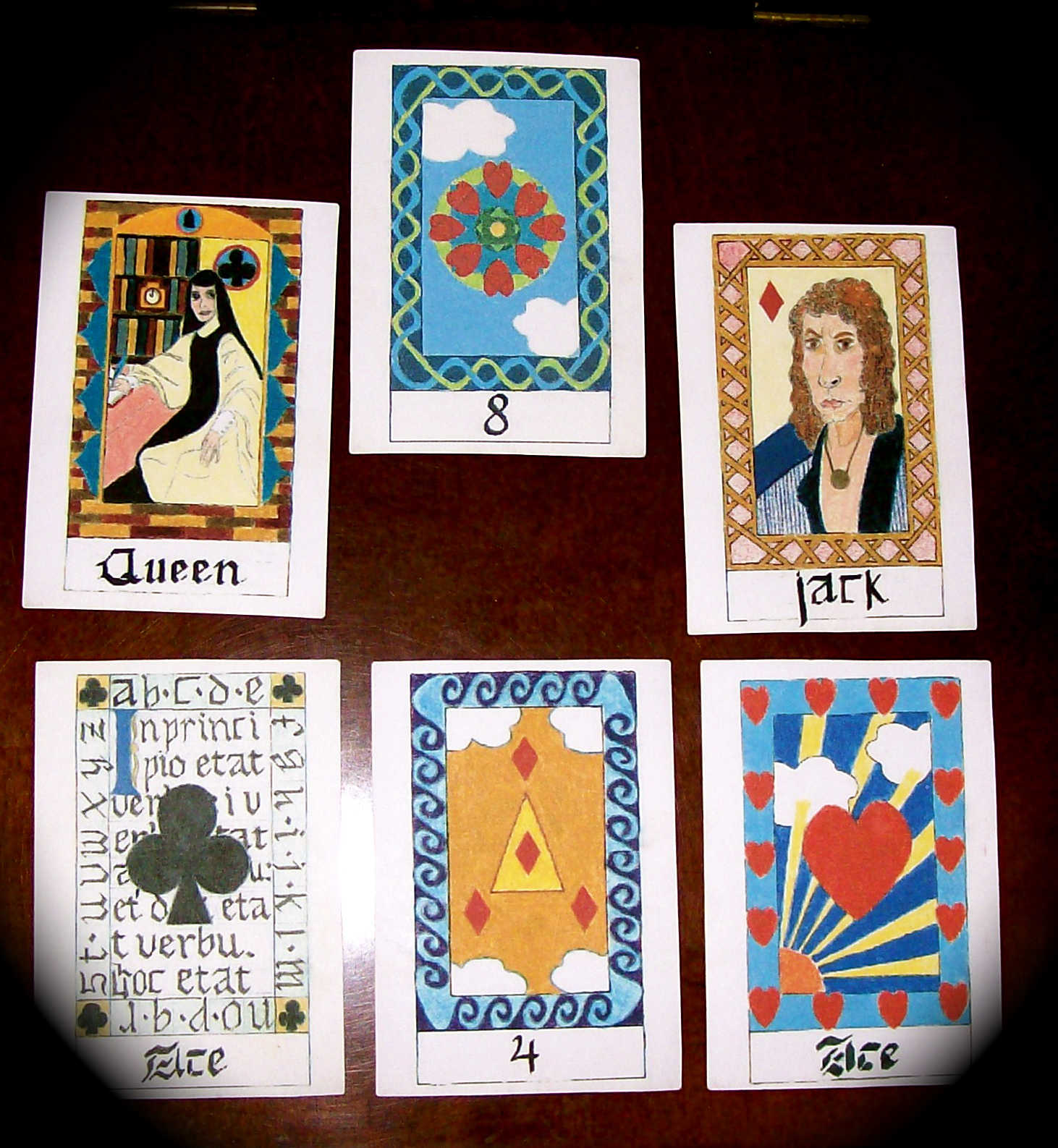
I decided to do the weekly reading with my old thumbed and tobacco-smelling Besançon cards, and glad I did. Just look at all that red!
What I'm finding is that it takes a month or so for understanding the specific meanings in the cards to come to fruition. This three-card spread from exactly one month ago is crystal clear now, but my interpretation at that time was hesitant and unfocused.
There was a lot of red in that layout too -- diamonds, instead of hearts, material concerns rather than relationships.
As my sisters and I prepare to sell my mother's place, which I'm living in momentarily, and close our parents' estate, the final act in another of life's chapters is signified in the reading of March 14 by the the nine, the number signifying an ending, and by the ten. Ten diamonds, the card of philanthropy and legacies, forecasts a successful resolution. In between them is my old girlfriend, the queen of clubs, telling me not to worry about any of this. No matter what, there's always the pleasure of reading and study.
Today's is the third reading since then, so I'm several behind, that is, the book is not yet closed on the two before this one, which speaks loudly either of romantic love or family relationships -- I think probably the latter. Seven cups (or hearts), one of the more complex cards, generally means some sort of betrayal, real or perceived, by someone close to us. But there's also a didactic element here, telling us to overcome bad faith with unconditional love.
Ten cups symbolizes acting out one's affection in relations with large groups of people. I always think of it as the performer's card. In this case, I think it bears more closely on what's happening with the seven cups, and forecasting that any friction or disagreement will be resolved successfully.
Between the cups, almost as a reminder, is a learning and knowledge card. The knight of batons, the Queen of clubs's younger brother, is on fire with the excitement of learning. I'm a little old to be a jack, but that's how I feel sometimes too.
I don't know whether I'll do a reading next week. I take these things seriously, and don't like having unresolved interpretive loose ends going back two, three, or four readings ago.
Sunday, April 14, 2013
Tuesday, April 09, 2013
the wages of sin
Ye gentle feast of Whitsuntide was come;
The woods and trees were clad in vernal bloom;
The full-awakened birds, from every tree,
Make the air ring with cheerful melody;
Sweet were the meadows after passing showers;
Brilliant the heaven with light, the earth with flowers.
Noble, the King of Beasts, now holds his Court;
Thither his summoned vassals all resort;
From North and South they troop, from East and West,
Of Birds and Quadrupeds the First and Best.
The Royal will had been proclaimed that all
Of every class should come, both Great and Small,
To grace the pomp of that high festival.
Not one should fail, and yet there did fail One;
Reynard the Fox, the Rogue was seen of none...
--Goethe
To be continued.
Illustration: an English engraving after the design of Wilhelm von Kaulbach (German, 1870-74).
See also "renard le renard" at catboxx.
Monday, April 08, 2013
change squared
How odd that with all the thinking, writing, reflecting, and talking about changes, the number five, and queens, I should draw a pair of fives and my old friend, the Queen of Hearts, whom I last saw in that same spot in December.
And there are a lot of changes going on in my life right now, My sisters and I are in the midst of deciding whether to sell this place I'm living in. Other big shifts afoot: physical, pharmaceutical, and cyber-spacey. So fives are appropriate.
Whether the shadow that accidentally fell on the photo, showing the passage of time moving from darkness to light, is also an omen I can't say at this point. One can hope, but "one never know, do one?"
I gave fast and dirty meanings for the two fives in the post immediately below this one, and to what I said about the five clubs there, Robert Camp adds that it can signify a change of residence.
Readings that have no trumps, such as this one, admit fewer possibilities for interpretation, and the suited cards tend to be blunt.
And of course there had to be a queen. I've drawn all four queens already this year; at least one and sometimes two each month. So now, here she is again, in the same place she appeared in December. The queen of hearts is always in the near future, like a mirage. It's like the white queen's rambling discourse about jam in "Through the Looking Glass:" "You get jam every other day -- so jam yesterday, and jam tomorrow, but never jam today. Every other day except this one."
Click on the picture for a bigger view. Photo and images on cards ©2012, 2001 by Dave B a.k.a. catboxer.
Friday, April 05, 2013
little things add up
Under ordinary circumstances, five spades is the most powerful five.
All fives in the deck (except trump V: the pope) are indicators of change, which occurs in that area of your life governed by the suit.
Five hearts is the breakup card; five clubs represents the inexact concept of changes in one's philosophy, way of thinking, or approach to a specific problem. Five diamonds indicates changes in income, or changes in the way one acquires it, or some other change in material values.
The suit of spades or swords governs our working lives and our health, prosaic matters which are at the center of where we actually live. Five spades generally signifies changes in the little things we do every day, such as when and how we brush our teeth and shower, diet, whether we exercise or not, and so forth.
It doesn't have to always mean that; for example five spades and five diamonds appearing in the same reading would seem to indicate a change in occupation or profession.
Whether these changes have occurred already, are happening now, or will happen some time in the future, depends on the card's placement in the reading.
Click on the image for a larger view. Photo, "five spades" and tarot card ©2013, 2001 by Dave B a.k.a. catboxer.
Tuesday, April 02, 2013
changes
From now on, I'm going to read weekly rather than monthly.
Tarot is an oracle, with its cards symbolically representing all manner of human conditions, situations, events, and tendencies. Precognition can be a tarot function (I've seen it work that way), but more often the read is about the present, and how it's developing.
From the three-card spread, I expect to learn 1) Where I've been recently, 2) where I'm at now, and 3) What this is leading up to (unless I change course).
Occasionally the oracle is wrong. Much more often, the oracle is right, but I misinterpret due to "attachments" in the Buddhist sense, commonly called "denial."
The most blatant and instructive incident of this type happened in 2003, when I got the breakup card (pictured here) in the third spot, and denied it could happen. But it did, of course. My marriage began unraveling three years later, and in 2007 we went our separate ways.
What I'm saying is the cards can be wrong, but if you know what you're doing, they're usually not.
I'm also available to read for others, at no charge for a three-card read. The catch is you'll have to ask me. Hint: to leave a comment, you must have a g-mail email account. It's the dictatorship of Google, and none of my doing.
The illustration, Five Cups, is a Mamluk playing card, a hand-painted luxury item from Egypt, whose Mamluk Dynasty ended in 1571. These were the direct ancestors of European playing cards. Venetian importers brought these 52-card decks to Italy between 1360 and 1375, where they were imitated and quickly spread throughout Europe.
European cards, though crude knockoffs at first, were more interesting than the Mamluk originals, because the latter had no "face" cards. Because of the Muslim prohibition on pictorially representing humans, their court cards, while beautiful, were personality-less abstractions.
Sunday, March 31, 2013
green lady
A while back I saw something in the news about a middle school where the administrators supposedly told the kids to call their Easter dance something else, because Easter is a Christian holiday and the school and religion are spoze to be the twain that never meet, & etc.
I have no idea if it was true or not, and it might have been from one of those stupid emails that get forwarded around u no the ones. Maybe some body got hoaxed by the Onion.
Whatever the case, what I find ironic in all this flapdoodle, plus in the fact that Easter is the ultimate Christian holy day, that it's the only holiday whose name remains an echo of paganism, and our pagan ancestors. In fact, Eostre was a beautiful Teutonic dawn goddess and great mother, the green lady, or in Latin, Primavera.
Furthermore, our method of determining the date of Easter is rooted in paganism, and as you'll recall, uses the full moon as a calendar marker. And since the moon waxes full on various dates, so then does the date of Easter which derives from it.
Eostre's totem animal is the fertile bunny, and her talisman the egg.
By some strange coincidence, there are 52 cards in a playing card pack as well, and four suits of 13 cards each, just as the four seasons are roughly 13 weeks each.
When Eostre was the ruler of springtime instead of Jesus there were 13 months, not 12. This is why, in Walter Scott's version of Sherwood Forest, Robin Hood and his men sang "How many months be there in the year? There be 13 I say..." And it works out, too, because 13 months X 4 weeks = 52 weeks.
But trying to compose a string theory based on cartomancy invariably butts up against the wall of hard numbers, because no matter how you add them up, 52 x 7 always makes 364, not 365.25. Once again, the crystal spheres and elaborate concordances of occultists take a beating. However, it's enough for some of us to know that the structure of a playing card deck is similar and corresponds in several ways to the structure of a calendar year.
Saturday, March 30, 2013
queens, a pair
As the earth warms and all the life living on and in her quickens in spring, our pace of life also picks up.
This is not the first time I've seen a similar configuration; this past September we drew a line of two queens enclosing a trump. However, that was a reading for a couple, and that line wasn't for me.
The queen of spades, whom I expanded on a little, recently, will pass from my life entirely (at least for a time) before long, in fact is already departing. "Goodbye to cares that bind me," as the song says.
I've also written at some length on trump #X, our old friend and enemy, rota fortuna. And even as we're lookin at this, the wheel is in motion.
It never stops completely, but sometimes goes faster, like now.
Then comes the queen of diamonds, a concerned person who likes to help, and has or controls much dinero.
I like having a lot of queens in my cards, and usually do. With today's addition of Diamond Lil, I've seen all four at least once each this past year.
Click on the picture for a larger view; photo: "Queens, a Pair" and images on cards ©2001, 2013 by Dave B, a.k.a. catboxer.
Wednesday, March 27, 2013
they shall look upon him whom they pierced
The jack of hearts, or knight of cups in the commonly-configured tarot deck, is one of the most dramatic cards in the pack, and one of the two or three most disturbing concepts among the suited cards.
Among readers who use a standard playing-card deck, this jack signals the need for personal sacrifice of some kind, and is sometimes called "The Christ card," or "card of spiritual sacrifice."
Like the crucifixion story, this image contains resonances with very early pre-civilized human psychology, including the instincts which prompted our Neolithic ancestors to practice human sacrifice.
The symbols in the frame, drawn from Mexican crucifixion iconography, echo this instinct as well as the passion story: the crown of thorns, hammer and tongs, the ladder and nails are there along with the sacred, still-living heart, the lily, and the Chi-Rho symbol of the early church, shown in obverse and reverse. The death's head and spilled wine, symbolizing the sacrificed blood, complete the symbolic content of this picture, along with the uncut loaf which contains the message of the prophecy found in John 19:33 "Not a bone of his body shall be broken."
The body language of the jack himself betrays no visible injury, but his expression communicates inner anguish: "They shall look upon him whom they pierced" (John 19:37 and Zechariah 12:10).
Sacrifice takes many forms in our lives, from the relatively mild abstentions of Lent to self-flagellation or mutilation in hopes that such sacrifice will speed redemption. This urge to "give something to God" in exchange for something the sacrificer desires is basic instinct, and the idea of sacrifice, small or huge, might be moderate or extreme, but remains deeply potent, even in our debased and degraded modern post-industrial-age lives.
Click on the image for a larger view. Photo and tarot card "The Jack of Hearts" © 2001, 2013 by Dave B, a.k.a. catboxer.
Saturday, March 23, 2013
xvi the tower
The tower is in your mind. It's the stronghold where we keep all our most unshakable, essential, and precious illusions.
When the tower is struck by lightning, it leads to great disillusionment, in the most literal sense. And quality of life really goes to hell for a while.
I don't know anyone who isn't reminded of the events of September 11, 2001 by any of the numerous modern versions of this image.
When the tower is struck by lightning, it leads to great disillusionment, in the most literal sense. And quality of life really goes to hell for a while.
I don't know anyone who isn't reminded of the events of September 11, 2001 by any of the numerous modern versions of this image.
This trump during its long history has not always been a tower. In fact, none of the other 21 picture cards has had as many different images and names as this one.
It's been called "the Fire," "the Arrow," "the Lightning," "the House of the Devil," "the House of the Damned," "the House of God," and "the House."
The infamous and legendary "Wicked Pack of Cards" book reports that in some early texts it was called "Hell," and say this was probably its original meaning, "although it possibly may rather have represented purgatory" ("Wicked Pack," p. 46).
Its presentation has included, besides the lightning-struck tower, an undisturbed tower with no human figures present, a burning building with corpses on the ground in front of it, a hell mouth spouting flames, into which a devil is pulling a man or woman, and a young man being struck by lightning.
Of all the images of trump, my fave is by the early Marseilles-deck artist and tradesman, Jacques Vieville. It was very early, and the only Marseilles deck I know of that doesn't always follow the "standard" designs. It also does not have the names of the trumps printed at the bottoms of the cards, a practice begun by the Marseilles tradition.
Vieville's card shows a young veck walking through a lightning, fire, or hail storm toward a tree under where sheep are sheltering.
Possibly, the meaning of this trump, like its succession of images, has evolved over time, was characterized by a lack of clarity early on, has been a source of confusion, and alone among the trumps was not clearly conceptualized by its originators.
Thursday, March 14, 2013
march madness
I've been spending time lately at the intersection of politics and morality -- a bad corner where a lot of wrecks happen.
As it turns out, the reading mostly concerns itself with money matters, and the oracle might be warning me to think about things closer to home than the Middle-East wars. Is that narcissism? I don't think so, because if I can't take care of myself, someone else will have to.
10 Diamonds tells me that the time of prosperity, having more money than is needed, is slipping away, and the end of a way of getting money is on the horizon. That's the scary card, that 9. The queen of clubs in the middle (I've seen her before, most recently last June) is telling me I need to read and study more, but I'm not sure on what subject.
What I'm getting is not a clear, specific instruction, but "Calm down, compose your mind, and pay attention to your personal situation, which is not all that stable."
Probably good advice.
I'll have more to say later, along with another picture. I can't get my camera to cooperate this morning, so I took this crude shot with my cell phone so as to have something to show.
Click on the image for a larger view. Photo and images on cards ©2013, 2001 by Dave B., a.k.a. catboxer.
Friday, March 01, 2013
red shoe dude
What a coincidence that just as I draw the cards for March, the real-life Pope is leaving. Unfortunately, he won't be taking his red shoes with him, which is a shame because red leather shoes would have to be a babe magnet. I don't much like this pope fellow, the real one or the one in my mind. He's got his good points -- he's a scholar and his opinion in his field of specialization carries some weight. But he's also an obvious case of arrested emotional development, captured by Diego Velazquez stunningly in his 1650 portrait of Pope Innocent X. My own pope is a crude rendition of Velazquez's famous oil.

Old Not-So-Innocent looks at the viewer with hostility and paranoia, as one would expect from someone threatened by plots from all sides. In this draw, he is fading from view. The Pope was once venerated, but I'm getting that he mostly no longer is. That means the meaning of this card has changed over time. I can't help seeing the Pope in a negative light.
Now I realize, of course, that in our brave new age, the fifth trump is generally called the high priest or hierophant or el queso grande or some other veschsh to try to uncouple this image from its Roman Catholic origins. Personally, I prefer the original names because the concepts behind them are simple and logical.
Ten clubs is unambiguous. It's a heavy scholarship card, and indicates someone reaping the rewards of years of hard work. If all it means is that I can write what I want, the way I want, that's fine by me.
Six spades, that one I'm familiar with. It's a "reaping" type card also. It shows up from time to time to remind me that I smoked for 50 years; it's the card of karmic results playing out in one's work and health.
Photo and images on cards ©2001, 2013 by Dave B a.k.a. catboxer
Saturday, February 23, 2013
recent past redux

I drew these cards back in the merry month of May, and had virtually nothing to say about them at the time. Click on the image to enlarge.
This is a reading for two people.
The suicidal king of hearts
Shuffles off stage left,
Slipping into the past,
Already fading.
New concerns crowd in;
A career ending upsets
The apple cart; love
Ending also is consequential.
In life's carnival, a magician
Packs his bag of cheap tricks
and moves on, but where to?
The bone man comes closer.
Come what ever he lived as a man
This time, no matter what comes now.
...30...
©2013 by Dave B a.k.a. catboxer.
Saturday, February 09, 2013
those honky-tonk blues
I was thinking some more about the fool, and fools in general. Here's another image of the fool, this one by the great Flemish 15th-century master, Hieronymus Bosch. Mouse click on the image to get a much larger and better view.
Some people refer to this picture as the Prodigal Son, and this young fool could be the type described in the New Testament parable. A young guy is tired of working on his dad's ranch, so he asks for his inheritance, takes it, and goes off to make his way in the world.
Except he doesn't. Instead, he falls into every trap the world sets for young guys, and his money is soon gone after a whirl of riotous living. Wine, women, song, and friends in predictably lower and lower places soon enough make a young fool of a guy get wise.
At this point the young guy is liable to be of the same mind as the late Hank Williams, Sr. when he sang:
I'm gonna pack my troubles underneath my arm,
And scat right back to my daddy's farm,
And lose these honky-tonk blues...
Bosch captures the fool just at that moment, as he turns his back on the life he's been living and heads for home. Behind him is the sleazy tavern where he's been drinking and, for the last few nights, sleeping, probably in the unroofed loft where someone's undershirt is presently hanging out the window. The families of pigs swilling outside the place remind him to his shame that he was fighting them for some of their food just yesterday. The pigs also reflect and comment on what goes on inside, where a couple of low-lifes stand making out in the doorway. That, and the intoxicated fellow pissing the wall tell us all we need to know about how this fool has been living.
And hasn't it made him a glorious sight? Only got one boot, raggedy-assed, beat-up, half-starved -- he's definitely had enough, and has turned his back to the tavern and all it represents, and turned his face toward home. The inevitable small animal, a growling dog in this case (Can somebody tell me why the fool is always accompanied or threatened by a dog or cat?) hurries him along, hat in hand and big wooden spoon at the ready, just in case he encounters something edible.
Poor fool! Fortunately for him, he's got a family farm to go home to. As he heads that way, a milk cow corralled behind a gate watches him tranquilly, blandly, without judgment, and timelessly, a look very much like the place he's returning to, where his father will watch him milking cows and say to himself, "He'll be all right; he's a good boy; he just needs to grow up."
Sunday, February 03, 2013
one card today
Decided to draw one card today, kind of a 'how's your now' card, and pulled Le Fou -- the one pictured here is approximately the same as the one I pulled from the Besançon Tarot.
The Fool is the most interesting card, because he has no place in the sequence. He originally had no number, not even the zero we give him today, because the earliest cards, even if they were numbered, used Roman numerals. There is no zero in ancient Roman arithmetic.
The homeless and possibly mentally ill vagrant and drifter symbolized by this picture likewise has no place in society, and is shunted by those with places to the very margins.
--30--
Thursday, January 31, 2013
living in the tarot
It's the queen of spades, of course, but I call this card "Hortensia" because it's a portrait of the woman who was my classroom aide for a number of years.
Hortensia suffered a terrible loss about the year 2000, when her oldest daughter, a married woman with chldren, died in a late-night car crash on a rural road.
Sorrow became a permanent part of the mother's personality, but she wore it well. She accepted the loss, and accepted she would never get over it. It was a beautiful thing to see, but I didn't understand how or why that could be until now.
If we contrast Hortensia's graceful mater dolorosa with the rule of forced optimism in our own culture, our cultural conditioning is found lacking. She was born in the USA, but Hortensia is Latina through and through and through, Tejana to be precise, and of that older, deeper, and in many respects wiser culture.
My own circumstances don't involve the kind of trauma my friend and associate went through, but they do cause some to despair. I'm reaching the time of life old Siddhartha was always bluntly talking about, the part where we all die. I've got a couple chronic illnesses that aren't going to go away, plus the usual blues that comes to old men, and goes
I used to be a lover, baby in my younger days... Ooh-hooooooooooooooooooooo, in my younger days,
Now I'm old and feeble, but I still got my lovin ways.
(--Texas Alexander with Cannon's Jug Stompers, "Rooster Crowin Blues)
I've got no reason to feel optimistic. On the other hand, it's never a good idea to despair. Life sucks, but even when it does it's almost always better than not-life, and plus this world might be the only one where the sunshine is.
When it comes to tarot cards, I'm definitely in the exoteric camp, admiring the work of real scholars like Stuart Kaplan and Michael Dummett, who is a skeptic besides. Dummett's grasp of history is comprehensive, but I don't share his skepticism about oracles.
I've used tarot effectively as an oracle and predictor of events, but its greatest value is as an advisor. That function of the cards certainly shines for me this month.
Photo and tarot card ©2001, 2013 by Dave B, a.k.a. catboxer. Click on the picture for a larger view.
--30--
Tuesday, January 29, 2013
for feburary, 2013
As promised...
See below, and mouse click on photo for a larger view.
Photo and images on cards ©2001, 2013 by Dave B, a.k.a. catboxer,.
--30--
strange days
Weird stuff today today. Decided to read for February, and for some reason got out my old Marseilles-style cards instead of my own.
My Marseilles-style deck is actually a Besançon tarot, from the town of Besançon in the south of La France, which means it's not an orthodox deck. The cardmaker replaced two of the traditional images in order to keep the Church authorities off his back. The local archbishop said two trumps, the pope, and the female pope, were blasphemous abominations & c., so the printer, Renault, swapped them out for Roman gods, Jupiter and Juno.
A while back I decided I could read with this lovely vintage deck of cards, but that either of the two "fake" tarot trumps showing up in a reading would void it. The old cards didn't feel right when I was shuffling them. They're five inches long and 2-3/4 wide (my cards are 4" x 3"), and felt eerie and unfamiliar passing through the hand. And sure enough, Juno turned up, so scratch that one.
I went back to my own cards, which have become so easy to read, and drew three cards for the month of February, a balanced reading with a pip, a face card, and a trump.
The pip, nine diamonds, is straight forward enough, signifying the end of a way of making money, but I already knew my teaching days are behind me.
The Queen of Spades, Lady Hortensia, is self-mastery. At my age and in my circumstances, what else is there?
The beautiful star is hope. It may be irrational as hell, but without it we're sunk.
A picture of the spread will follow.
--30--
Monday, January 14, 2013
an emperor for our time
I'm always looking for pictures that could serve as modern tarot cards, especially trumps. Here's "The General" by Saul Steinberg (1970), which I see as a 21st-century trump IV -- the emperor.
The general, like the emperor, is the ultimate secular authority. He speaks in a thick, nearly impenetrable bureaucratic jargon, a formula for fabricating engines of destruction. He is considerably less human than the emperor, almost robotic. It's a sign of the times.
It would be a fun project to look for tarot trump images in the great artworks of our own and earlier times, like this one.
--30--
Wednesday, January 09, 2013
card back
This is the image I used for the backs of the cards in my self-designed deck of tarots.
It was not originally intended as part of a deck of cards, but was simply something I doodled on an idle summer's afternoon in San Francisco years ago.
I drew and colored it in 1968 using pencil, a double-zero Rapidograph borrowed from my artist girlfriend, and magic markers on paper. It's 5" x 7", so it fit perfectly for use with my original tarot images, which are also five by seven.
The fronts of the cards were done between 1997 and 2001.
Click on the image to get a larger view. Photo and drawing ©2001, 2012 by Dave B, a.k.a. catboxer.
Saturday, January 05, 2013
baffled
Right. Well I managed to get a better image of this read (see post immediately below), but as the image has gotten clearer the meaning has gotten cloudier. These cards must be someone else's.
The momentum of the spread is toward romantic love. I'm going to be 69 years old this year, so that makes no sense at all.
The second theme in this layout is learning and study, which fits better with the true state of affairs. There's also a subtext of fiscal prudence and financial stability. I guess it's pretty much in the ballpark except the hearts. Unless I'm misreading them.
But I don't think I am, and that looks like someone else's life. But whose?
Click on the picture for a bigger view. Photo and images on cards ©2012, 2001 by Dave B a.k.a. catboxer.
--30--
Subscribe to:
Posts (Atom)