Saturday, February 09, 2013

those honky-tonk blues

I was thinking some more about the fool, and fools in general. Here's another image of the fool, this one by the great Flemish 15th-century master, Hieronymus Bosch. Mouse click on the image to get a much larger and better view.

 Some people refer to this picture as the Prodigal Son, and this young fool could be the type described in the New Testament parable. A young guy is tired of working on his dad's ranch, so he asks for his inheritance, takes it, and goes off to make his way in the world.

 Except he doesn't. Instead, he falls into every trap the world sets for young guys, and his money is soon gone after a whirl of riotous living. Wine, women, song, and friends in predictably lower and lower places soon enough make a young fool of a guy get wise.

 At this point the young guy is liable to be of the same mind as the late Hank Williams, Sr. when he sang:

I'm gonna pack my troubles underneath my arm,
And scat right back to my daddy's farm,
And lose these honky-tonk blues...

Bosch captures the fool just at that moment, as he turns his back on the life he's been living and heads for home. Behind him is the sleazy tavern where he's been drinking and, for the last few nights, sleeping, probably in the unroofed loft where someone's undershirt is presently hanging out the window. The families of pigs swilling outside the place remind him to his shame that he was fighting them for some of their food just yesterday. The pigs also reflect and comment on what goes on inside, where a couple of low-lifes stand making out in the doorway. That, and the intoxicated fellow pissing the wall tell us all we need to know about how this fool has been living.

 And hasn't it made him a glorious sight? Only got one boot, raggedy-assed, beat-up, half-starved -- he's definitely had enough, and has turned his back to the tavern and all it represents, and turned his face toward home. The inevitable small animal, a growling dog in this case (Can somebody tell me why the fool is always accompanied or threatened by a dog or cat?) hurries him along, hat in hand and big wooden spoon at the ready, just in case he encounters something edible.

Poor fool! Fortunately for him, he's got a family farm to go home to. As he heads that way, a milk cow corralled behind a gate watches him tranquilly, blandly, without judgment, and timelessly, a look very much like the place he's returning to, where his father will watch him milking cows and say to himself, "He'll be all right; he's a good boy; he just needs to grow up."  

Sunday, February 03, 2013

one card today

Decided to draw one card today, kind of a 'how's your now' card, and pulled Le Fou -- the one pictured here is approximately the same as the one I pulled from the Besançon Tarot.

 The Fool is the most interesting card, because he has no place in the sequence. He originally had no number, not even the zero we give him today, because the earliest cards, even if they were numbered, used Roman numerals. There is no zero in ancient Roman arithmetic.

 The homeless and possibly mentally ill vagrant and drifter symbolized by this picture likewise has no place in society, and is shunted by those with places to the very margins.

--30--

Thursday, January 31, 2013

living in the tarot

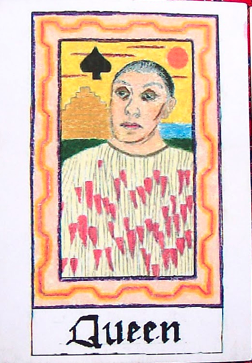
It's the queen of spades, of course, but I call this card "Hortensia" because it's a portrait of the woman who was my classroom aide for a number of years.

 Hortensia suffered a terrible loss about the year 2000, when her oldest daughter, a married woman with chldren, died in a late-night car crash on a rural road.

 Sorrow became a permanent part of the mother's personality, but she wore it well. She accepted the loss, and accepted she would never get over it. It was a beautiful thing to see, but I didn't understand how or why that could be until now.

 If we contrast Hortensia's graceful mater dolorosa with the rule of forced optimism in our own culture, our cultural conditioning is found lacking. She was born in the USA, but Hortensia is Latina through and through and through, Tejana to be precise, and of that older, deeper, and in many respects wiser culture.

 My own circumstances don't involve the kind of trauma my friend and associate went through, but they do cause some to despair. I'm reaching the time of life old Siddhartha was always bluntly talking about, the part where we all die. I've got a couple chronic illnesses that aren't going to go away, plus the usual blues that comes to old men, and goes

I used to be a lover, baby in my younger days... Ooh-hooooooooooooooooooooo, in my younger days,
 Now I'm old and feeble, but I still got my lovin ways.

(--Texas Alexander with Cannon's Jug Stompers, "Rooster Crowin Blues) 

I've got no reason to feel optimistic. On the other hand, it's never a good idea to despair. Life sucks, but even when it does it's almost always better than not-life, and plus this world might be the only one where the sunshine is.


 When it comes to tarot cards, I'm definitely in the exoteric camp, admiring the work of real scholars like Stuart Kaplan and Michael Dummett, who is a skeptic besides. Dummett's grasp of history is comprehensive, but I don't share his skepticism about oracles.

 I've used tarot effectively as an oracle and predictor of events, but its greatest value is as an advisor. That function of the cards certainly shines for me this month.          

Photo and tarot card ©2001, 2013 by Dave B, a.k.a. catboxer. Click on the picture for a larger view.

--30--

Tuesday, January 29, 2013

for feburary, 2013

As promised...


See below, and mouse click on photo for a larger view.

Photo and images on cards ©2001, 2013 by Dave B, a.k.a. catboxer,.

--30--

strange days


Weird stuff today today. Decided to read for February, and for some reason got out my old Marseilles-style cards instead of my own.

 My Marseilles-style deck is actually a Besançon tarot, from the town of Besançon in the south of La France, which means it's not an orthodox deck. The cardmaker replaced two of the traditional images in order to keep the Church authorities off his back. The local archbishop said two trumps, the pope, and the female pope, were blasphemous abominations & c., so the printer, Renault, swapped them out for Roman gods, Jupiter and Juno.

 A while back I decided I could read with this lovely vintage deck of cards, but that either of the two "fake" tarot trumps showing up in a reading would void it. The old cards didn't feel right when I was shuffling them. They're five inches long and 2-3/4 wide (my cards are 4" x 3"), and felt eerie and unfamiliar passing through the hand. And sure enough, Juno turned up, so scratch that one.

I went back to my own cards, which have become so easy to read, and drew three cards for the month of February, a balanced reading with a pip, a face card, and a trump.

The pip, nine diamonds, is straight forward enough, signifying the end of a way of making money, but I already knew my teaching days are behind me.

The Queen of Spades, Lady Hortensia, is self-mastery. At my age and in my circumstances, what else is there?

The beautiful star is hope. It may be irrational as hell, but without it we're sunk.

A picture of the spread will follow.

--30--

Monday, January 14, 2013

an emperor for our time

I'm always looking for pictures that could serve as modern tarot cards, especially trumps. Here's "The General" by Saul Steinberg (1970), which I see as a 21st-century trump IV -- the emperor.

The general, like the emperor, is the ultimate secular authority. He speaks in a thick, nearly impenetrable bureaucratic jargon, a formula for fabricating engines of destruction. He is considerably less human than the emperor, almost robotic. It's a sign of the times.

It would be a fun project to look for tarot trump images in the great artworks of our own and earlier times, like this one.

--30--

Wednesday, January 09, 2013

card back


This is the image I used for the backs of the cards in my self-designed deck of tarots. 

It was not originally intended as part of a deck of cards, but was simply something I doodled on an idle summer's afternoon in San Francisco years ago.

I drew and colored it in 1968 using pencil, a double-zero Rapidograph borrowed from my artist girlfriend, and magic markers on paper. It's 5" x 7", so it fit perfectly for use with my original tarot images, which are also five by seven.

The fronts of the cards were done between 1997 and 2001.

Click on the image to get a larger view. Photo and drawing ©2001, 2012 by Dave B, a.k.a. catboxer. 


Saturday, January 05, 2013

baffled

Right. Well I managed to get a better image of this read (see post immediately below), but as the image has gotten clearer the meaning has gotten cloudier. These cards must be someone else's. The momentum of the spread is toward romantic love. I'm going to be 69 years old this year, so that makes no sense at all.

The second theme in this layout is learning and study, which fits better  with the true state of affairs. There's also a subtext of fiscal prudence and financial stability. I guess it's pretty much in the ballpark except the hearts. Unless I'm misreading them.

But I don't think I am, and that looks like someone else's life. But whose?

Click on the picture for a bigger view. Photo and images on cards ©2012, 2001 by Dave B a.k.a. catboxer.

--30--

Tuesday, December 25, 2012

reading for the new year


With the snow falling thick and fast on Christmas Day and beginning to accumulate, it's a good time to take a sounding on what's in store in the year ahead.

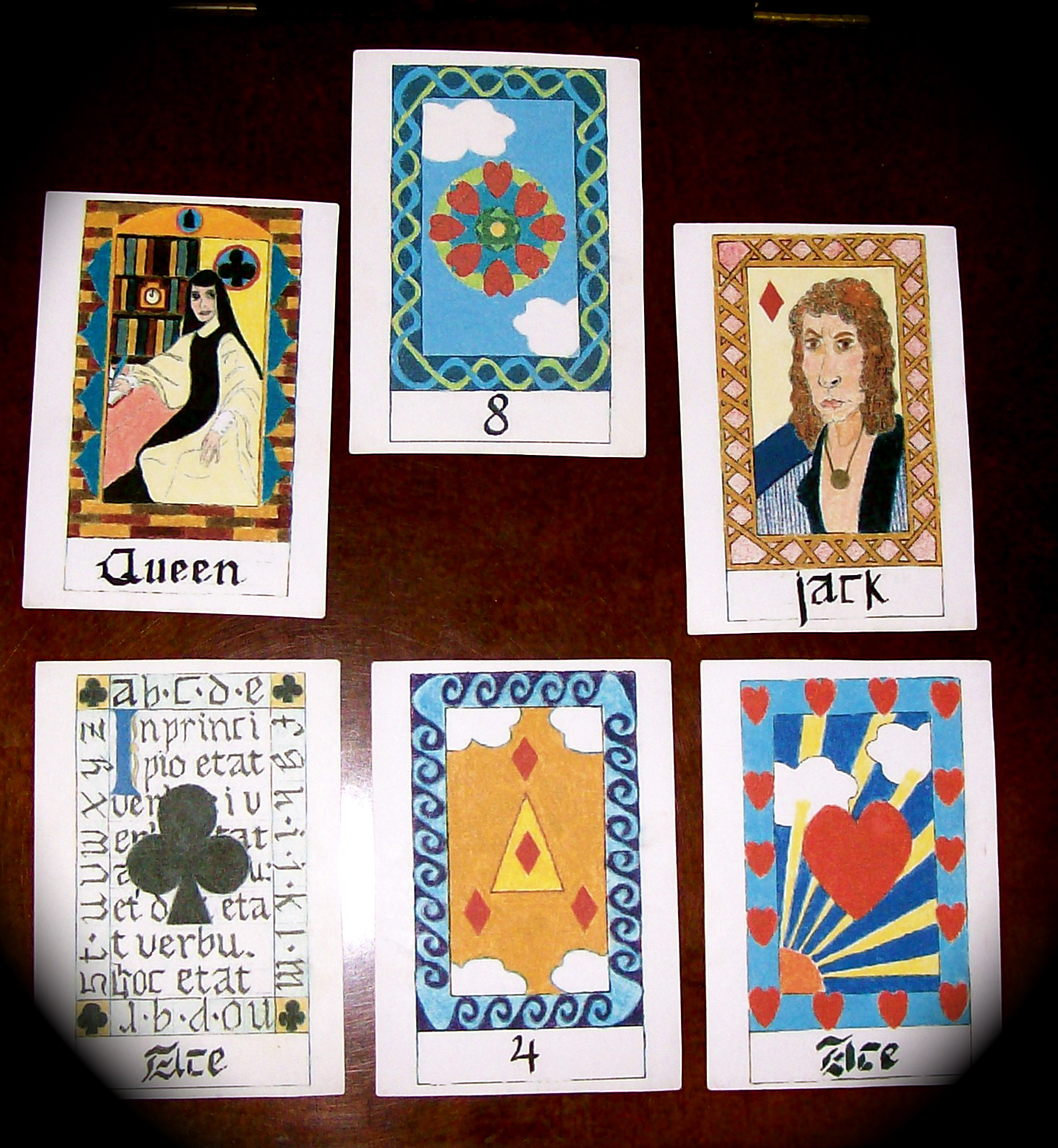
I used a new and, as far as I know, original layout this time, designating the bottom line of three cards as predicting developments in the gross or physical sphere of life, the pair just above forecasting the more abstracted, internal, and mental life, and the ultimate card at the top showing next year's focus of the spirit, geist, soul, or simply "the self."

The frequently symmetrical and seemingly patterned state of the cards I randomly draw (as in this case) looks deliberately arranged. At the bottom, a pair of aces bracket the four diamonds, and the center is a perfectly balanced pair of face cards.

The ace of clubs is all about new directions in reading, study, and learning. Hardly a month goes by that I don't draw a club card pointing to the importance in my life of this ongoing habit. Just as the ace of clubs means a desire for knowledge, or a new plan, scheme, or way of communicating, its partner, the ace of hearts, means a new love affair, or the desire for one, and the timing of this image is appropriate.

Between them is the four diamonds, representing financial stability and that most elusive of modern conditions, a balanced budget. That's a nice prospect, since it's one of my goals for next year.

Then comes the poetic, articulate, and knowledge-loving queen of clubs, consorting here with the materially-oriented, intelligent and calculating, and somewhat humorless money manager, the jack of diamonds -- a hard card to play I've heard.

At the top is love triumphant, and a romance brought to fruition,   which at my age seems silly to contemplate, but who knows what might happen? Life is full of surprises.

So while I may be obsessed with studying art and art history next  year, and will have my mind on my money and my money on my mind, this reading predicts that as always, love has dominion over all human affairs.

You can click on the picture for a bigger view, but it won't necessarily be a better one. My digital camera is misbehaving this morning as it oten does, so I used my cell phone to snap this one. If I get a better photo in the next couple of days, I'll replace this one.

Images on cards ©2001, 2012, by Dave B. a.k.a. catboxer.

Sunday, December 23, 2012

unlucky 13

So 2012 turns out not to have been the end of the world, but just another bad hair year.

 Actually, it seems to me that the first 13 years of the new century have been more or less uniformly sucky.

 I'm hoping that cycle, whatever it was, has run its course.

 --30--

Tuesday, December 18, 2012

self portrait


                May, 2012

Sunday, December 16, 2012

counter-images

I never read with reversed cards, because I've always felt like doing so would compromise clarity.

However, it occurs to me that many of these images have reverse or upside-down meanings, and that some of these are seen as commonplace images in popular culture. For example, here is the anti-queen of hearts, drawn towards the middle of the 19th century, by John Tenniel, to illustrate Lewis Carroll's "Alice's Adventures Underground."


And here is Carroll's less finished, and less comical, but decidedly scarier version of the same subject. It conveys the same nightmarish and at the same time slapstick impression as the rest of the book.

--30--

Friday, December 14, 2012

for a friend


I did this spread of three some time back, on the internet for a friend.

It's an unusual layout because two of the three cards are trumps.     The likelihood of drawing two trumps to a three-card spread is about .088, that is, it will happen slightly fewer than nine times out of 100.

It's also an unusually auspicious consultation, anchored by the chariot trump, sometimes called "Victory."

Leading up to this period of triumph over enemies or circumstances is the creative and abundant empress trump.

Leading away from it is the security of financial stability, achieved with much difficult work which has yielded positive results.

Update: Look closely at the three cards, and you will spot two sevens, making this layout doubly auspicious.

The motto for this spread is "Ad astra, per asperam" (To the stars, with difficulty).

Click on the image for larger size and better clarity. Photo (2012) and images on cards ©2012, 2001, by Dave B, a.k.a. catboxer.

--30--


Tuesday, December 11, 2012

lone wolf reading

I'm used to seeing more cards than this, but now that I'm no longer half of a couple, I've reverted to the three-card monthly summary. The breakup has been gestating for a while, and was forecast in September.

No trumps here, but plenty of weight, starting with 10 pesos at left. This usually indicates that the subject of the reading, or "querent" as the person is sometimes styled, will do or has recently done (the latter in this case) a philanthropic act for a deserving person or people. It took me a while to figure out that in this case I'm the recipient of the gift, not the benefactor, since I recently moved back into the paid-for condominium my mother left to me and my sisters. Rents in Seattle have become very dear, and it's really nice to have a lovely and affordable place to keep the rain off.

The centerpiece, six spades, is the present moment, and the karmic result. Spades concern one's health and work, those closely interrelated facets of each of our lives. When this card shows up, it's telling us our habits and attitudes, good or bad, have determined the state of our health and work. For some reason this card often is feared, and so interpreted negatively. I had terrible health habits, and terrible health for many years, and pretty bad work habits as well, partly a result of poor health. The two chronic illnesses I have were one result. But for the last five years I've cultivated excellent health habits -- the usual lineup -- not smoking, close attention to diet, daily exercise -- and the results have been what my yoga grand-teacher Gary Kraftsow calls "optimal."

Also, I'm working. I'm a writer now. I don't get paid, but I write, take it seriously, and do it every day. And the only requirement for being a writer is to write.

Looking ahead, I see a lady. Another lady? Probably, and I don't think the Queen of hearts needs any interpreting. I've seen her before and not all that long ago, only she was behind me at the time rather than on the way ahead, which is also the only way we can go.

Mouse click on the image for a much larger and better view. Photo     (2012) and tarot cards ©2001, 2012, by Dave B, a.k.a. catboxer.

--30--

Monday, December 10, 2012

Siggy


The picture was painted by Carl Jung as an illustration for his "illuminated manuscript," The Red Book, and shows Sigfried killing the dragon. Mouse click on the picture for a much larger and clearer view.

Sometimes I'll look at this and see myself fighting my diseases -- emphysema and Parkinson's -- and winning with the help of medication. If you're going to fight dragons, you can't be afraid.

-- That's "30" for now --

--Etaoin Shrdlu

Friday, November 30, 2012

why 74?

People sometimes ask me why my deck of tarot cards has 74 cards instead of the usual 78. I decided I wanted my work to have two definite characteristics, and achieving them involved some consideration.

 First of all, I wanted my cards to have the look and characteristics of two distinct entities, thus 22 picture cards are grafted onto a modified 52-card playing card deck. This was the process by which tarot was originally created in Italy over 500 years ago, and if the usual suited tarot cards are different from the suited cards in my deck, they were, just the same, the playing card deck with which 15th-century Italians were familiar.

 The originators of tarot added, besides the 22 picture cards (21 trumps + the fool) four cards to the suited portion of the pack (the queens), yielding four court cards in each suit, and 14-card suits. To our modern eyes, the tarot knight seems the interloper, but the Egyptian decks which were the forerunners and provided the template for European playing cards, were 52-card affairs with three courts in each suit -- the king and two male deputies.

The other characteristic I wanted in my tarot deck was to incorporate the playing-card pack the whole world uses today, the "international" deck with its 13-card suits. Its French-originated suit signs are really no different from the ones in a standard tarot deck, because hearts = cups, clubs = sticks, diamonds = coins, and spades = swords. And 13, a mysterious and  prime number, works better than 14 for a suit of cards. There are four suits and four seasons, as well as four elements in the ancient concept of the physical universe. There are 13 weeks in a season and 52 weeks in a year. There's a certain mystical fascination with the number 13 in the lore of the early days of the US, and of course, the sinister association of the number with death, and its significance in the myth of the Last Supper.

 There is a traditional line of thought that says the tarot deck was created out of whole cloth, as a seamless entity. This is easily disproved, since the importation of playing cards preceded the invention of the trumps, and the former, modified by the addition noted above, were clearly grafted onto the latter. A person could read with either part of the deck -- with the trumps alone or with the playing cards alone -- and in fact readers have employed both techniques at various times and places. Personally, I prefer the results of reading with the combined deck.

Photo and images on cards ©1968, 2001, 2012 by Catboxer a.k.a. Dave B.

--30--

Monday, November 26, 2012

the breakup card

The five hearts is the breakup card; that's for sure. At least I've never known it to be anything else.

 When it showed in September I recalled the last time, in March of 2003, when it appeared in the same place -- top line, center of a nine-card "magic square," the sum of the future's spot -- as in the September recently passed.

 In that earlier appearance, I wrote at the time that it looked like my wife and I would be breaking up at some point in the not-too-distant future, even though at that time the relationship appeared strong, almost bulletproof. But it wasn't, and dissolved over a period of months in 2006 and 2007.

Trying to figure out where I am right now with this manifestation        of the old "cinco de corazones." Are we through with that thing and done with it, or is there more to come?

 The thing about the suited cards, or Minor Arcana as some people like to call them, is their blunt and crystal-clear meanings, as opposed to the trumps, which are large and vague enough to lend themselves to endless re-interpretation.

 I've considered attempting to read in the traditional Gypsy style, with a playing-card pack. That would produce an extremely blunt reading indeed.

Sunday, November 04, 2012

going into winter

There was no reading in October.

November's first interesting feature is that all three cards in the bottom row, indicating the recently unfolding past, were in September's spread.

The two trumps this month's fall in the upper left corner, as if the momentum of the reading is leaning toward the future and the feminine side.

Last month m'lady had eight hearts in the center (present) position in her (left-side) file; this month it's moved to the bottom, and its former spot is occupied by five clubs, signifying major changes in one's outlook, goals, and point-of-view.

The top of the file is the trump VIII - fortitude, usually called "strength" today. Its meaning is exactly what the name suggests.

The hub of this spread is three hearts: indecision and confusion in matters of love.

The right-side file, or male side of the reading, begins with the ace of spades, which was at the center of September's read. Four diamonds signifies stability in financial matters, but at a very modest level; restraint and discipline in money matters is necessary. At the top, six hearts is some karmic debt pertaining to love.

The center card at the top is the III trump, the empress, whose pregnancy promises a time of creativity in material pursuits.

Click on the photograph for a larger view.

See also, the September reading, posted immediately below.

Photograph and images on cards ©2001, 2012 by Dave B, a.k.a. catboxer.

Wednesday, September 26, 2012

september song


The reading's only trump card, in the middle of the bottom row, reminds me of I Ching hexagram 51, whose judgment reads in part, "First laughing words -- ha ha; then shock comes -- ah ah!" So it was with us, beginning with laughter and infatuation, then quickly moving into a process dominated by fear and resentment. 

It was the two queens, standing like protectresses on either side of the tower, who enabled us to get through that time. Hers, the pensive queen of spades, whose spiritual nature was formed out of pain and loss, and my queen of clubs. Even though she wears the habit and has taken the vow, she's more about knowledge and learning for its own sake than spiritual matters.

The lady's eight of hearts is indicative of "considerable emotional power, charm, and personal magnetism," according to Robert Camp*, and these qualities have enabled her to completely subdue the heart presently entwined with her own. The jack of clubs is the current unfolding of an ongoing theme, and the enthused young student is the most intense of all learners, cooking up spectacular results in his mind's oven when his subject is fresh, new, and exciting.

The ace of hearts usually means a new love relationship, or the desire for one. In this case it might mean an established relationship becoming new once more, like a flowering annual. The five of hearts next to it usually means a divorce, a breakup, or leaving one's family home. In this case, it more likely forecasts a significant change of residence which will occur November 1.

The nine of clubs tells us that whatever the jack is working so hard on will be completed in the near future. Robert Camp says of this card "it will signal a time when some ideas, ways of thinking or communicating, or some personal plans...are ready to end." This implies a new stage in one's thinking as well, possibly a synthesis of new material and old learning, with profitable results.

In the middle of it all, dominating the reading and drawing all the sequential lines of the spread's narratives into himself, sits the large, mute, and inscrutable ace of spades, the great keeper of secrets. He intervenes between the shock of recognition and the move across the water, pointing the way. He links the sadness of the mater dolorosa,, queen of spades, and the necessity of giving up familiar but obsolete ways of thinking. He also connects the queen of learning with the renewal of romantic love, and yokes the charisma of the center-left card with scholarly absorption on the right.

The ace of spades makes a cloudy lens, but it's through that we need to view these cards.

*All quotes from Robert Camp are from: Destiny Cards, (Sourcebooks, Inc., Naperville, IL), 1998.

Click on the image for a larger view. Photo and designs on cards ©2001, 2012 by Dave B, a.k.a. catboxer.


Tuesday, September 11, 2012

fancy and the ace of spades

Paul Christian was a 19th-century French journalist, historian, and occultist whose real name was Pitois. Cynthia Giles's "The Tarot: History, Mystery, and Lore," with its compact but comprehensive history section, includes a couple of pages on M. Christian and his work. Although Gile's discussion is intelligent and informed, she doesn't mention that it was this fellow Christian who originated the terms "major arcana" and "minor arcana."

Those names for the two divisions of the tarot deck, with their aura of mystery and mossy old age, go back to...1870? And they were just the point of departure for an elaborate, beautiful, over-the-top Oriental fantasy that culminated with initiation, underneath the pyramids, into an ancient Egyptian "mystery" religion, where neophytes were led into the circle composed of "78 gold leaves" which had once been housed in an extremely ancient temple in Memphis.

And so forth. "No factual basis was offered for the tale," Cynthia Giles notes, "but it swiftly became a part of the burgeoning background to the occult movment," along with the similar work of the American Ignatius Donnelly with his theory of the lost city of Atlantis. Even the golden plates found in a cave by another American, Joe Smith, who founded a new religion, were a similar sort of 19th-century fancy. Whether any of them actually believed what they wrote out of their exuberant imaginations is open to debate.

Christian was a scholar who got appointed to a position in the Ministry of Public Education at 28. His job was to sort through thousands of old books the revolutionary government had seized from monasteries in 1790, and a lot of them dealt with magic and alchemy. This was weird stuff for the modern age and, I imagine, pushed the young writer in occultic directions.

The thing about occultism is, it's the basis for an awful lot of contemporary approaches to tarot. If we don't have it, what have we got?

To start, we have a deck of cards, or rather two decks of cards, or to be very precise, a deck of 52 cards to which were added 4 court cards and 22 picture cards.

When I designed my own tarot, I decided to keep the 52-card deck and eliminate the 4th-ranked court card, and keep the queens and the usual 22 picture cards, making a deck of 74. Why there are usually four court cards in a tarot suit I don't know; it might have something to do with scoring the game, for the invention of the tarot pack as a gaming device which only later came to be used for divination, is beyond dispute.

There's a beauty and balance to the regular 52-card pack that I wanted to incorporate into my own. It mostly has to do with the 13-card suits, 13 being such a deliciously mysterious and immaculately prime number, compared to the clunky 14. Also, I grew up with the French suit signs, or the International deck as it's called nowadays, so adding the trumps to it seemed natural, just as adding them to a playing deck with suits of cups, sticks, coins, and swords would have seemed natural to a 15th-century Italian designer of games.

While they may seem plain as vanilla to aficionados of fanciful or occult tarots, some of the playing cards, even with their minimal imagery, resonate deeply in our culture: who doesn't understand the meaning of the queen of hearts, for example?

The Ace of spades is one of these. An ominous card, one of three associated with death (the others are the nine spades and, of course, trump XIII), the ace of spades conceals a secret. It was the center card in our reading this past weekend, and it sat there huge in the middle of the read, mute and secretive.

It was so big and so secretive I find it very disturbing.